FIRST CHAPTER SNEAK PEEK
Going up for preorder soon!
Chapter One
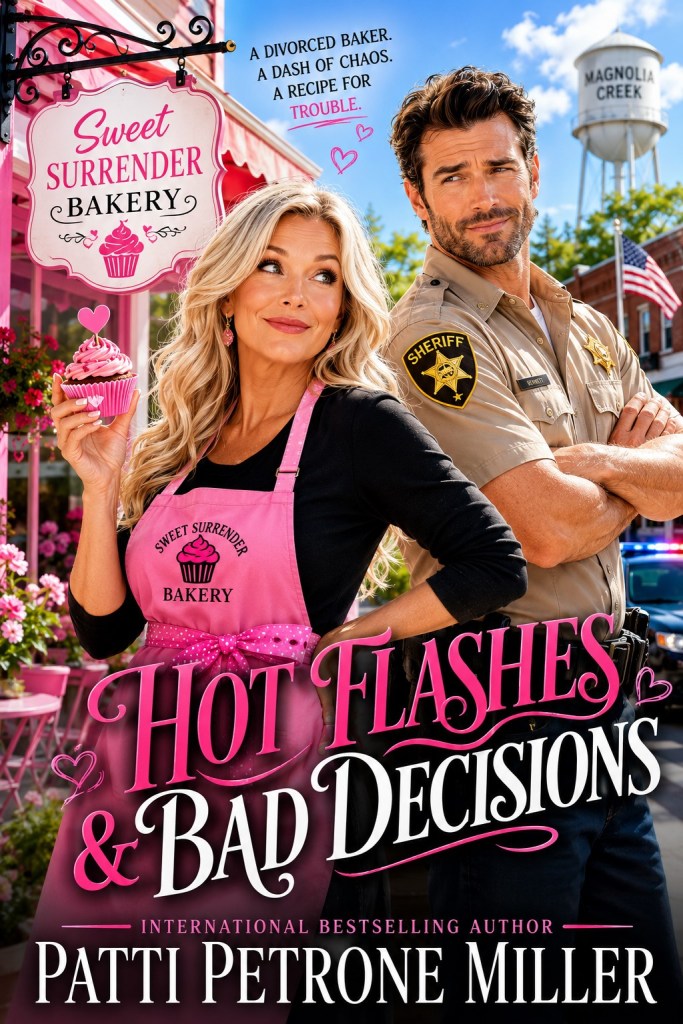
The oven came to life at four in the morning with a low whoosh and a smell of warm metal, and Beth Callahan stood in front of it in her grandmother’s apron and her ex-husband’s old reading glasses and decided, for the nine hundredth time, that fifty-two was a ridiculous age to start over.
The glasses were the only thing she had kept of Gary’s, and she kept them out of spite. He had left them on the bathroom counter the morning he announced, over scrambled eggs, that he had fallen in love with a yoga instructor named Brittany who could touch her own ankles to the back of her head. Beth had nodded very calmly and finished her coffee and then driven straight to the bank, and three weeks later she had a lease on a narrow brick storefront on Main Street and a name painted in gold on the window. Sweet Surrender. The sign man had asked if she was sure about the name, and Beth had told him she had never been more sure of anything in her life, which was a lie, but a good one.
Flour drifted across the worktable like fine snow, soft and pale under the hanging lights, and Beth pressed her palms into the cool dough and let the rhythm settle her nerves. Knead, fold, turn. Knead, fold, turn. The recipe lived in her hands now, passed down from Grandma Ruth through her mother and into Beth’s own fingers, and there was something steadying about it, the way the dough pushed back against her like it had opinions. Outside the front window, Magnolia Creek slept on in the soft gray hush before dawn, the streetlights buzzing faintly over the empty square, the gazebo a pale ghost in the middle of it all.
Then the heat hit her.
It started at the base of her spine, a slow furnace bloom, and climbed up her back and across her shoulders and into her face like she had stuck her whole head in the oven she had just lit. Beth gripped the edge of the table and breathed through it, sweat beading along her hairline and rolling down between her shoulder blades, her cheeks flaming a furious red she could feel without a mirror.
“Not now,” she muttered to her own traitorous body. “We are working.”
Her body did not care. Her body had decided, somewhere around her fiftieth birthday, that it would no longer cooperate with weather, schedules, or dignity, and that it would announce this decision at random intervals with all the subtlety of a fire alarm. Beth fanned the neck of her apron and stuck her face in front of the little box fan she kept clipped to the shelf, and the cool air ruffled the loose gray-brown wisps at her temples and dried the sweat to a salty crust. Through the window the sky had begun to pale at the edges, a thin band of peach pushing up behind the rooftops, and somewhere down the block a screen door banged and a dog barked twice and went quiet.
The flash passed the way they all did, leaving her clammy and slightly insulted, and Beth went back to the dough.
Her phone lit up on the counter at half past five, buzzing its way across the steel toward a tray of muffin liners, and Beth knew before she looked who it would be. She wiped her hands and answered with the phone tucked between her ear and her shoulder.
“I’m alive,” Beth said into the phone, sliding a tray into the oven.
“I didn’t ask if you were alive,” her daughter said, in the carefully patient voice of a young woman who had read one article about parents living alone and had not recovered. Casey was twenty-six and lived two hours away in the city and had appointed herself, somewhere in the divorce, the official supervisor of her mother’s emotional wellbeing.
“You were going to.”
“I was going to ask how you slept.”
“Like a baby,” Beth lied cheerfully, because she had slept four hours and spent two of them sweating through her sheets and the other two awake doing the bakery’s books in her head. “How’s that man of yours?”
The trick, Beth had learned, was to redirect Casey toward her own life, where there was a boyfriend named Drew and a job she liked and a whole future that did not need watching. Casey took the bait, the way she always did, and chattered happily for a few minutes about Drew and his promotion while Beth moved around the kitchen in the gathering light, pulling butter from the cooler, cracking eggs one-handed into a bowl, the shells crunching with a small wet snap and the yolks sliding out fat and orange. The smell of vanilla and warm sugar began to fill the room, rich and buttery, curling into every corner.
“You’d tell me if you were lonely,” Casey said suddenly, and there it was.
“Honey,” Beth said, “I have a town full of nosy people and four hundred cupcakes to frost. I have never been less lonely in my life.”
This was almost true. The loneliness lived in the cracks now, in the quiet of the apartment over the shop, in the second pillow she still could not make herself throw away, but it was smaller than it had been, shrinking a little more each week, and Beth had decided not to feed it. She hung up after extracting a promise from Casey to eat a vegetable and a return promise from herself to text when she locked up that night, and she set the phone down and looked at the rising light through her gold-lettered window and felt, for one clean unguarded moment, almost happy.
Then she got to work in earnest, because happiness was nice but the lunch crowd was nicer, and the lunch crowd liked their lemon cupcakes.
The morning unspooled in its usual floury blur. The cinnamon rolls came out gold and glistening, and Beth slid them into the case behind the counter while the icing was still warm enough to slump just right. The bell over the door jingled at six sharp, and Patsy Crabtree blew in on a cloud of hairspray and indignation, her bright copper bob lacquered into a helmet that could survive a hurricane, a takeout cup already in each hand.
“You are not going to believe,” Patsy announced, setting one of the cups in front of Beth and not waiting to be asked, “what Dolores Pruitt said at the salon yesterday about the Founders’ Day pie committee.” Patsy ran the Curl Up and Dye two doors down and considered herself less a hairdresser than a public utility, a clearinghouse for every fact, half-fact, and gorgeous fabrication that passed through Magnolia Creek. Beth had learned to sip her coffee and let it wash over her.
“Tell me everything,” Beth said, because resistance was pointless and the gossip was free, and she leaned her elbows on the counter while Patsy unloaded.
By seven the diner crowd had spilled over, and Dot Mabry came down from the Bluebird for a box of cinnamon rolls she insisted were for her customers and ate two of in the kitchen with her own hands, brushing crumbs off her bosom and complaining about the price of bacon. Dot was built like a fire hydrant and ran her diner like a battleship and had fed three generations of the town from the same twelve recipes, and she looked at Beth’s cupcakes with the suspicion of a woman who did not trust anything with that much frosting on it. Maggie Sutton drifted in around eight, quieter than the other two, a paperback tucked under her arm and her reading glasses pushed up into her gray-streaked hair, and she bought a single lemon cupcake and a coffee and stayed in the corner reading, which was Maggie’s whole personality and the reason Beth loved her best.
The four of them were not friends so much as a natural formation, the way some rocks just end up leaning on each other, and Beth had not expected, at this age, in this strange new life, to be handed a set of women who would notice if she went missing. It was the second best surprise of her divorce. The bakery was the first.
The morning sun climbed higher and the heat came with it, pressing against the glass, and the air conditioner over the door rattled and dripped and lost its long daily war against a Southern June. Beth frosted and boxed and rang up and chatted, and the bell jingled and jingled, and somewhere in the warm sugary swirl of it she nearly forgot, for two whole hours, that her landlord wanted her gone.
He reminded her at eleven.
The bell jingled, but it jingled differently, or maybe it only seemed that way afterward, and Randall Pierce filled the doorway of her little shop in a pale linen jacket and a smile that did not reach anywhere near his eyes. He smelled of expensive cologne and cigar smoke, a heavy cloud that rolled in ahead of him and settled over the warm vanilla like a tarp, and the whole bakery seemed to cool by ten degrees the moment he crossed the threshold. The handful of customers at the little tables went quiet, suddenly very interested in their coffee.
“Bethie,” Randall said, leaning one manicured hand on her gleaming display case, leaving a print. “We need to talk about your lease.”
Beth straightened up behind the counter and felt her spine do it on its own, the way it had learned to do in the last hard year. “We can talk,” she said pleasantly. “Cinnamon roll? On the house.”
“I don’t eat sugar.” He said it like a virtue, his eyes moving around her shop, over the gold lettering and the fresh paint and the cheerful striped awning she had paid for herself, and there was a hunger in the way he looked at it that had nothing to do with cake. “Pretty little place. Shame.”
“What’s a shame?”
“I’m not renewing.” Randall smiled wider, and a back tooth flashed gold. “Nothing personal. I’m consolidating the block. Bigger plans coming for Main Street, and a cupcake shop run by a divorcee with no business head doesn’t quite fit the vision.” He picked a cupcake off the tester plate by the register, a lemon one, her best one, and turned it in his fingers like he was appraising it. “You understand.”
The heat climbed Beth’s back, and this time it was not menopause.
She understood perfectly. She understood that she had sunk her settlement and her courage and a year of her life into this floor, and that this smiling man wanted to peel it off the street like a sticker, and she understood, all at once and very clearly, that she was done being told what she could not do by men in nice jackets. The words came out of her before she had finished choosing them.
“You know what, Randall? Get out of my shop.”
A teaspoon clattered onto a saucer somewhere behind her. Patsy, who had wandered back in for a refill, sucked in a breath you could have heard from the gazebo.
Randall laughed, an easy practiced laugh that made Beth want to throw something. “There’s the temper. No wonder he left you.” He took a slow bite of her lemon cupcake, chewed it, and made a small dismissive face, like it was fine, like it was nothing, and walked toward the door with it still in his hand. “Sixty days, Bethie. Enjoy your little dream while it lasts.”
The bell jingled behind him, cheerful and oblivious, and the cologne hung in the air for a long minute after he was gone.
Patsy got to her first. “I have his cousin’s number,” she said grimly, gripping Beth’s arm. “And I know three things about his marriage that would curl your hair without a single chemical.”
“I’m fine,” Beth said, which was the family motto and a complete lie, and she busied her shaking hands wiping down the case where his palm print sat fat and accusing on the glass. Maggie appeared at her elbow without a word and started boxing the morning’s leftovers, and Dot, who had heard the whole thing from the doorway, announced to the room that Randall Pierce had been a snake since the seventh grade and that snakes generally got what was coming to them. The little crowd murmured agreement, and the warmth crept back into the bakery one cinnamon roll at a time, and Beth let the women fuss over her because that was what the women were for.
The rest of the day passed in a bruised sort of normal, the lunch rush and the afternoon lull and the long golden slant of light through the front window as the sun finally tipped toward the rooftops. Beth made and sold and smiled and seethed, and by closing she had talked herself most of the way down off the ledge, because sixty days was sixty days and she had survived worse on shorter notice. The bell jingled its last customer out a little after six, and the quiet that followed was a good quiet, soft and earned, the case half empty and the till respectably full.
She did the floors and the counters and the long boring closing list, and she carried the day’s trash bag out to the alley behind the shop the way she did every single evening, hip-checking the heavy back door open and stepping into the warm dim hush between the buildings.
The alley smelled of warm asphalt and old grease from the diner’s vent and the green river-smell that drifted up from the creek a block over. The light back there was the deep bruised purple of summer dusk, the brick walls still breathing out the day’s heat, a single bulb over the back door buzzing and pinging as the first moths found it. A cricket sawed away somewhere near the dumpster. Beth swung the bag up toward the lid out of long habit, her mind already on the shower and the second pillow and the text she owed her daughter.
Her shoe caught on something soft.
Beth looked down, annoyed, expecting a feed sack or a dropped delivery box, and her brain took a strange slow second to make sense of the shape on the ground in the bad purple light. There was a pale linen jacket. There was a manicured hand flung out across the gravel, fingers loose. There was the back of a head she knew, and a dark stain spreading out beneath it that was not, her stomach insisted, was absolutely not, motor oil.
The trash bag slipped out of her fingers and split on the pavement, and oranges and eggshells and a hundred crushed cupcake wrappers spilled across her shoes, and the smell of it rose up sweet and rotten in the heat.
Randall Pierce lay behind her dumpster, very still, very pale, and very, very dead.
And there, in the gravel beside his slack open hand, the paper peeled back, one bite gone, sat a single lemon cupcake from Sweet Surrender Bakery.
For a long moment Beth could not do anything at all but stand there with her heart slamming against her ribs and a hot flash blooming up her neck at the worst possible time in the history of the world, the cricket sawing on, the moths pinging the bulb, the warm dead weight of the evening pressing down on the alley like a hand. Somewhere on Main Street a car door slammed and a familiar deep voice called good night to somebody, and Beth thought, with the strange clear calm of a woman whose whole life has just tipped sideways, that of all the people who could come around that corner right now, of all the people in all of Magnolia Creek, it was going to be the sheriff.
It was going to be Wade Bennett.
Of course it was.
Beth opened her mouth, and what came out was not a scream and not a word but a high cracked sound she did not recognize as her own, and the deep voice on Main Street stopped mid-sentence and went sharp.
“Hello? Somebody back there?”
“Wade.” Her voice scraped out of her, thin in the purple dark. “Wade, you need to come back here. Right now.”
Boots hit the pavement at the mouth of the alley, quick and certain, and a tall shape rounded the corner with one hand already dropping toward his belt, and Beth Callahan stood over the body of the man who had ruined her morning, ankle deep in spilled trash, sweating through her grandmother’s apron, with the evidence of her own bakery glinting in the gravel beside the corpse, and understood that her brand new life had just gotten very, very complicated.
Discover more from Patti Petrone Miller
Subscribe to get the latest posts sent to your email.
